Coogee Media
HISTORY | STORIES | BEYOND BLOG & CREATE PEOPLE |
Dan CurtinLast of the Soap Box Orators
Forgotten Local Leader
Who was Dan Curtin? Curtin also became a union activist and an organiser of the Boilermakers' Society. He and his brother were leading members of that union. According to the Communist Party's newspaper The Tribune in 1947, during their time with the Boilermaker's Union, Dan Curtin was as "right-winger" and his brother Bill, a "left-winger". They may well have called him a "right-winger", but this did not make any less a vocal supporter of worker's rights. Supporting the labour movement became the primary focus of his political life. He worked at Cockatoo Island Dockyard during World War Two, contributing to warship construction, including that of the Tribal class destroyer HMAS Warramunga.
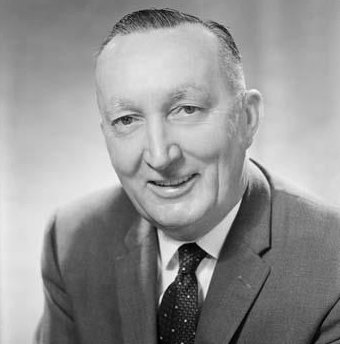 Daniel Curtin, 1962 (NAA 30451913) In February 1947, the Premier and state member for Redfern, William McKell, resigned to take up the position of Governor-General. Dan Curtin threw his hat into the ring for preselection for the Labor nomination for McKell's safe Labor state seat of Redfern. Curtin was defeated in the preselection by George Noble (1891 - 1947) who then won the seat at the general election of May 1947. However, Noble died suddenly in July 1949, 26 months after his election, opening a race for the seat of Redfern again, but by then Curtin had set his sights on a federal seat.
Dan Curtin defeats Max Falstein for Federal Seat Max Falstein (1914 - 1967) was well-educated, intellectually brilliant, handsome, and energetic. He was at first seen to have the prospect a promising political career and as a future Labor leader. Yet, his blunt, impetuous personality led him to reckless unproductive clashes with authority and the holding angry grudges. He won the seat of Watson in the House of Representatives for Labor in 1940. As an ally of Arthur Calwell and his supporters, he became a bitter opponent of the leadership of Prime Minister John Curtin (no relation to Dan Curtin). Despite being a member of Parliament, Falstein enlisted in the Air Force as a pilot during the World War 2, but clashed with superior officers. His career was also marred by dubious business ventures such as being convicted of understating the value watches he imported in 1948. By 1949 the Labor Party had had enough, and rescinded his endorsement as the Labor candidate for Watson, opening the way for Daniel Curtin to nominate and gain the Labor Party's endorsement. (see note 2) Falstein contested the seat in the 1949 election as an "independent Labor". In a bitterly contested campaign Curtin won the seat, beating both the conservative Liberal candidate and Falstein. Curtin held Watson until 1955.
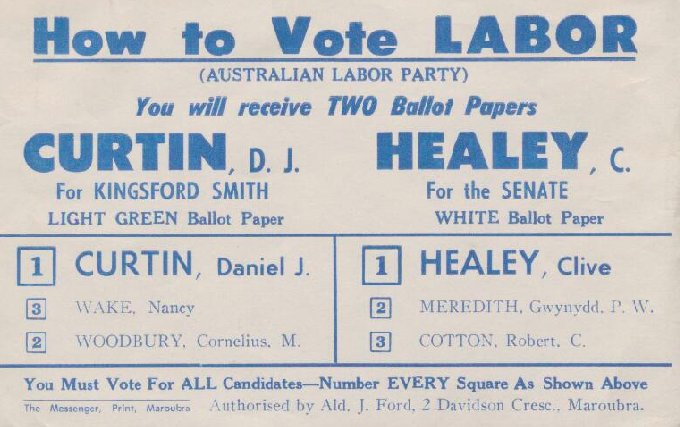
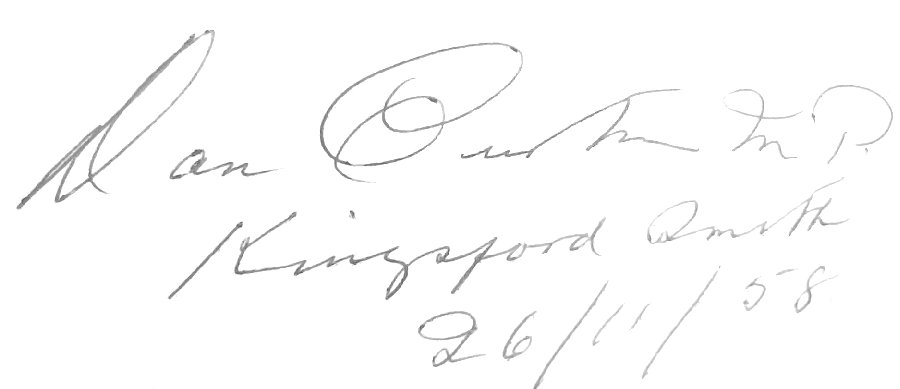
Transfer to Electorate of Kingsford-Smith Curtin the firebrand, was a vastly different personality than Gordon Anderson.
Dan Curtin's Personal Life Curtin met Ruby Dalton, a widow and mother of a daughter and two sons, who worked as a social welfare officer for the New South Wales Labor Council. She helped Curtin during his 1949 election campaign and after the election, became his secretary. They married on Saturday 1st November 1952, at the City Registry Office. She was forty-four and he was fifty-four. Curtin was described as a widower and grandfather. The only guests at the wedding ceremony were Mr. Curtin's daughter and son-in-law Mr. and Mrs. Reg White, and two old friends, Mr. and Mrs. H. Sawyer, of Maroubra. They later met friends other relatives for a reception at their new home, an apartment in a block of flats at Little Street in Maroubra. Several hundred people attended a public reception organised by Maroubra Bay A.L.P. Branch Kingsford in early November 1952 and presented Mr. and Mrs. Curtin with gifts of a clock and utility set. She said, "We've been engaged for a long time, but only recently managed to get somewhere to live for when we get married. I first met Dan when he was a union official. We've both been interested in politics and industrial matters for years. I don't expect any diamonds and furs out of this marriage. Dan's so generous he gives half his salary to needy people and to good causes."
Forceful Debater And so, Curtin maintained this combative style of politics throughout his political career. There was no doubt that he saw politics through a class-warfare, pro-Working-Class lens. One dramatic example of Curtin's assertive style was in 1953 when Curtin managed to raise the ire the conservative Liberal Party speaker of the House of Representatives, Archie Cameron, when he interjected during a debate on Communist Party Dissolution Bill in March 1953. Cameron suspended Curtin, ordering him to leave the House and the Parliament building. Curtin left the House, but took the view that the Speaker had no authority over the portion of old Parliament House controlled by the Senate and theatrically stationed himself on a halfway marker on the Senate side of King's Hall. When the House adjourned and members left the chamber, Curtin took great delight in ceremoniously bowing deeply to Cameron as he passed by. Cameron was enraged and later in the House threatened to begin proceedings to charge Curtin with contempt of the House. Curtin soon returned to the House, but it took many apologetic words from the opposition leader Bert Evatt to smooth things over with Cameron. Curtin had a knack of getting under Cameron's skin and in April 1954 received a rebuke from the Speaker for attempting to surreptitiously hum a farewell song at the closing of the 1954 session. The conservative press frankly did not like Curtin or his brand of politics. It mocked his voice and style of debate. The noted political pundit, Alan Reid, said of him in an opinion piece in the Sun Herald in December 1953:
DAN CURTIN, Labour member for Watson, who possesses a shrill voice, a modest talent for low-brow comedy and a gift for rendering those parrot-like catchcries that have kept generations of politicians in well-paid jobs, recently told the Parliament with great force and no originality ...
Last of the Soap Box Orators Because of Curtin's liking for the traditional style of political campaigning of giving speeches on street corners from portable platforms to whoever may have been passing by, he gained the reputation of being the "the last of the soap-box orators". He sometimes complemented his booming voice with loudspeakers. On one occasion in April 1951, he was giving a speech on Anzac Parade at Maroubra Junction when police arrived. He was, they informed him, parked on the wrong side of the road and was less than the required distance from a street corner and he would have to move on. Curtin took this as a major attempt to censor him and angrily lodged complaints with the Police commissioner.
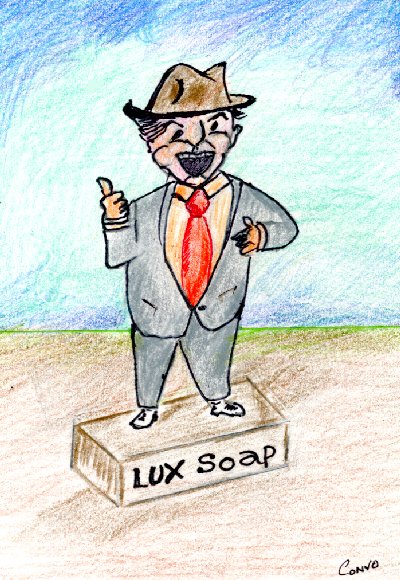 Last of the Soap Box Orators
Aboriginal Affairs
Attempting to Judge the Man Curtin supported federal funding for surf life-saving equipment; he advocated for federal assistance to local governments for rat infestations; and he promoted upgrading anchorages in Botany Bay so that it could become a deep-water port. In April 1963, he was campaigning for better conditions and food service at the Bunnerong Migrant Hostel, Maroubra, but his attempts were stymied by a refusal of the Hostel's manager to allow him to inspect, something that he raised in Parliament. In 1956 Curtin was liaising with a committee from the Maroubra Surf Life Saving club for a campaign to prevent the mining of rutile on Maroubra beach. This would be unthinkable now, but it was a very real possibility then, particularly as the argument of the day was that rutile was important for defence. It was an early foray into environmentalism. Curtin was keen to see large swaths of federally owned land in his electorate put to community use. He thought that the ANZAC rifle range on Malabar Headland should be subdivided for housing - he estimated it could accommodate 1200 house blocks. He wanted the Defence Department to vacate stores buildings that had be constructed during World War 2 in what became Heffron Park, so that the land could be converted to recreational use. And he wanted the Commonwealth to transfer vacant bushland behind Conwong Bay to be used for public recreation. Ironically, it was a former opponent, Liberal MHR Jim Killen, who was the one to acknowledge Curtin's death most fully in 1980, saying that he was a tough but generous opponent. His wife, he said, likely wrote all his speeches. Though he had a boisterous character, Curtin did not take part in debates for the sake of it: "Jimmy, slug it out, but always give a point of view". He was also extraordinarily generous; Killen knew of a colleague to whom Curtin handed a bundle of cash when that person was in urgent need, even though he also was a political opponent.
Retirement
References
Note 1: In those days, electoral law did not regulate the names of political parties, and candidates could incorporate any term into the political designation they used. Hence, Falstein was entitled
to use the term "independent" Labor, even though not endorsed by the Labor Party.
Note 2: Having lost the 1949 election for Watson to Dan Curtin, Max Falstein, then living at Everett Street, Maroubra, continued to attract controversy in numerous press reports regarding the payment
of bills for the printing and distribution
of election material. Cyril Hertz of 3 Ormond Gardens Coogee, described as a "campaign worker", sued Falstein for the non-payment of "work done included the distribution of 6000
copies of a newspaper run by Falstein, called Fair Play, 6000 how-to-vote cards, 11,000 photos and 11,000 printed sheets." Falstein claimed that Hertz was only entitled to ₤25, but a
court eventually ruled in Hertz's favouring awarding him another ₤41.
Note 3: The federal seat of Kingsford-Smith has been represented by six members, all from the ALP. They are:
| CONTACT US | ABOUT US |
|