HISTORY | STORIES | BEYOND BLOG & CREATE PEOPLE |
Elioth GrunerThe Great Australian Artist who Painted CoogeeAustralian Impressionist Elioth Gruner (1882 - 1939), one of Australia's most famous artists, created a series of small, luminous paintings of Coogee Beach during his highly productive period around 1912 to 1918, when he spent weekends bodysurfing and painting en plein air along Sydney's coastal suburbs.
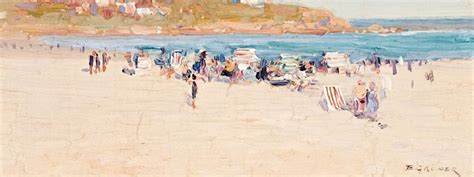 Figures at Coogee by Elioth Gruner Several of Gruner's notable paintings feature Coogee and what was then called Little Coogee (now Clovelly). They include:
All, except one, are held in private collections. Only Figures at Coogee (1913) is held in a public collection by the National Gallery of Australia in Canberra, although other works by him are held in all the major Australian galleries.
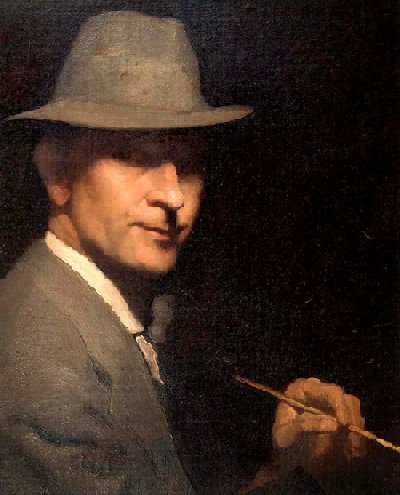 Elioth Gruner self portrait Key Characteristics of Gruner's Beach Works Elioth Lauritz Leganyer Gruner was born on 16 December 1882 at Gisborne, Poverty Bay, New Zealand, younger son of Elliott Gruner, bailiff, and his Irish wife Mary Ann (d.1922), nee Brennan. His father, of German ancestry, had migrated to New Zealand from Christiania, Norway. In 1883 the family settled in Sydney. Elioth Gruner became a draper's assistant at 14 and attended art classes at Julian Ashton's art school. From the age of 14 he was working punishingly long hours in a drapery to support his widowed mother and family, leaving only a few short periods to learn and practice his art. From October 1901 Gruner exhibited regularly with the Society of Artists, Sydney, and from 1907 attracted serious attention. An important admirer was Norman Lindsay; from about 1913 he frequently visited Lindsay at Springwood, where he painted with Harley Griffiths. Despite the responsibility of supporting his mother, Gruner left his job in 1912 to manage the Fine Arts Society's Bligh Street gallery and shop, dealing solely with Australian art. In 1914 he became an assistant at Ashton's Sydney Art School, but did not like teaching. In 1915 he visited Melbourne and painted with Griffiths and with Max Meldrum, whose tonal theories strongly affected his vision. In 1912, the family moved to Bondi and Gruner spent several productive years roaming the eastern Sydney coastline from Bondi to Coogee, bodysurfing with his friends and painting.
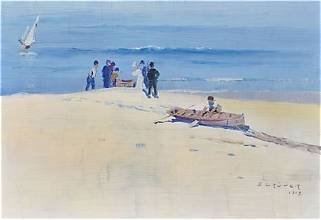 Fishermen at Coogee by Elioth Gruner (1913) He spent time in the Canberra region in the from the 1920s, and the Canberra/Monaro region continued to be a favoured area for subjects. He also visited the National Gallery of Victoria to see Corot's 'The Bent Tree'. He assisted with the organization in 1916 of an exhibition of the work of J. J. Hilder, (read more about J. J. Hilder here) whose influence was also important. He also travelled to Europe in 1923 after his mother had died, spending about two years away immersing himself in Europe's artistic culture. Gruner won the Wynne Prize for landscape painting seven times, the most of any Australian artist besides Hans Heysen. He held a one-man show in 1927 and, not being a particularly productive artist, sold almost everything he produced.
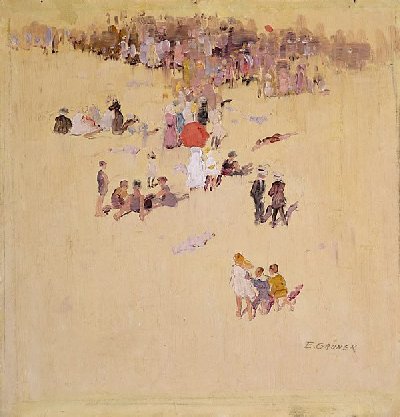 Bondi by Elioth Gruner (c1912) Despite experimenting with modernist techniques while he was in Europe where he admired the works of Gauguin and Cezanne, like many representational artists of his generation, he was uneasy about the artistic direction of the avante-garde movement and the spread of modernist influences in Australian art. In 1938 he joined the Australian Academy of Art, the anti-modernist foundation established by the conservative Attorney-General of the time, Robert Menzies. As a member of the organisation, Gruner exhibited his artwork with them. Gruner continued to live in the area around Bondi, Tamarama and Waverley until his death. Despite his impoverishment in his early days, by his later years he was earning a good living from his painting and was able to buy a house at Tamarama. Throughout his life he battled depression and alcoholism. Gruner was gay, and in those straitlaced days his partner, Brian Cannell, was referred to in press reports as being his secretary or travelling companion (after Gruner's death). A biographer and friend, W. G. Buckle, said that though he was a shy and unassuming man he was very popular in art circles, to the extent that when he went on camping trips to paint, he tried to keep his whereabouts secret because admirers had a habit on visiting him and talking for long hours about his work. In 1938, while painting at Acton in the A.C.T., Gruner was visited by the Governor-General Lord Gowrie to see him paint (Gruner seems to have been happy for the visit on this occasion). When Gruner died of chronic nephritis on 17th October 1939, he left an estate worth £1928 and 20 paintings. He had no known descendants. He was generally acknowledged in the general press and art publications as being Australian greatest contemporary landscape artist. Gruner's Coogee paintings remain small but radiant windows into the Eastern Suburbs coastline as it was more than a century ago. His work is a luminous chapter in Coogee's cultural story, reminding us how deeply artists have been drawn to this stretch of coast and how powerfully it continues to inspire. References
|
Copyright © Coogee Media All rights reserved
First uploaded 12 Oct 2026
| CONTACT US | ABOUT US |